Showing posts with label Mathematics. Show all posts

Thursday, 25 August 2016

GCSE Results 2016

GCSE results across England, Wales and Northern Ireland this year have suffered a significant fall. This is in marked contrast to last week's A-Level results, which showed a great deal of stability when compared with recent years. GCSE results peaked in 2011 after a long period of "grade inflation", and have been falling year on year ever since.

Of the five million results being released today, the proportion of entries being given A* to C grades has fallen from 69% to 66.9%, an unprecedented fall of 2.1%. The proportion of top A* and A grades was down overall by 0.9% to 13%. Awards of the very top A* grade have also fallen slightly, down from 6.6% to 6.5%.

One reason for the fall in the overall pass rate is that more pupils in England are re-taking GCSE English and maths, following measures by the government to attempt to ensure that all pupils reach a grade C in these subjects. As a result there were re-sits for tens of thousands who did not reach a C grade last year. Among over 16s, GCSE entries were up by 380,000, up roughly 25% on last year.

By subject, there were falls in the pass (A*-C) rate in maths (down 2.3%), English (down a worrying large 5.2%) and in other subjects.

But even without the re-sit figures, there was a fall in the results of 16 year olds, with the proportion getting A* to C falling by 1.3%. It is thought that a move to an alternative qualification, the iGCSE, for many able students, may account for some of the drop.

While the overall results were downwards, in Northern Ireland the proportion of passes increased slightly to 79.1% and top A* grades rose to 9.3%. In Wales, the level of A* to C passes remained at 66.6%, with A* grades rising slightly to 6.1%.

Girls continue to do better than boys at GCSE. The A*-C rate for girls was 71.3% compared with 62.4% for boys, a gap some would describe as worrying, or even unacceptable. The percentage of entries gaining A* grades for girls was 7.9% and 5.0% for boys.

Next year will start to see the phasing in of a radical change to the way that GCSEs are graded. The new GCSE exams will be graded from 1 to 9 (with 9 the highest), rather than the current A* to G.

Friday, 5 June 2015

Hannah's Sweets

Quite a few GCSE students were stumped by a question about Hannah's sweets on yesterday's higher tier Edexcel paper.

The question was:


Hannah has 6 orange sweets and some yellow sweets.
Overall, she has n sweets. She takes one sweet from the bag and then another.
The probability of her taking 2 orange sweets is 1/3.
Prove that: 


The question is not actually that difficult if you remember how tree diagrams work.

When Hannah first takes a sweet there are 6 orange sweets out of n, so the probability of her choosing orange is 6/n.

When she chooses her second sweet there are now only 5 orange (if she chose orange the first time) out of a total of n-1 sweets.
You multiply the probabilities along the branches of a tree diagram, so


 Multiplying the 2 fractions on the left gives:

Cross-multiplying gives:


Thursday, 14 August 2014

A-level maths now most popular subject

Pupils in England, Wales and Northern Ireland receive their A-level results today and they appear to have fallen slightly this year.

The Joint Council for Qualifications, issuing the results, said there has been a slight fall in A* and A grades and the overall pass rate is down for the first time in over 30 years. The percentage gaining the very highest A* grade has risen from 7.6% to 8.2%. 8.5% of boys' grades were A*, with girls' grades at 7.9%.

A-Level results this year are "broadly stable".

For the third successive year overall A* and A grades have fallen slightly (this year down from 26.3% to 26%), but exam officials are saying A-level results are broadly "stable".

For school leavers planning to go to university, there are suggestions this could be an unusually good year to apply. There are a record number of university places on offer this year - over 500,000 for the first time, which is a rise of over 30,000. Students may still get places even if they have missed their grades. The Ucas admissions service says initial figures show a 2% increase in students getting their first choice place.

Education Secretary Nicky Morgan says the government is "lifting the cap on aspiration". Universities Minister Greg Clark says the increase in the number of places is an "important source of social mobility".

There is a trend for more students to take so-called "facilitating subjects" at A-level, such as maths and physics, which can help university applications. Maths is now the most popular subject, overtaking English this year for the first time.

It is the first set of results following the Government's scrapping of January A-Level sittings. However, the fewer opportunities to take modules does not seem to have affected students' overall performance too badly.

Regarding other proposed changes, Labour's shadow education secretary Tristram Hunt said he would reverse the government's plan to remove the link between AS and A-levels. This de-coupling of the two exams would limit young people's "opportunity to realise their full potential", said Mr Hunt.

Would you like to share your results story with us? Comment on this article, or email info@mathsbank.co.uk.

Monday, 25 February 2013

Brightest Shine Less Brightly At 16

Institute of Education
Institute of Education (Photo credit: Wikipedia)
A new study has highlighted the differences in mathematical ability between the children of different countries at different ages. According to researchers at the Institute of Education in London, England's brightest primary school pupils are on a par, mathematically, with the those from Taiwan and Hong Kong. But by the time pupils reach 16, the comparative performance achieved by the top 10% falls. Overall the English pupils came 28th out of 65 countries at this age.

When looking at the average scores of the entire cohort, the pupils from east Asia performed better than those from England at all ages, but the gap didn't widen as the pupils became older.

What is going on here? There is no doubt it is disappointing, but what or who is to blame?

a) The curriculum? Is the curriculum too narrow at secondary school? There is no doubt that the very brightest pupils in UK schools will absorb everything they are taught. So are we simply not teaching enough? Do the top 10% need extra challenges?

b) The teaching? There is a long-standing debate over whether, as a society, we value the work of teachers enough. Would increasing the average pay of teachers encourage better, more inspirational teachers into the classroom? Would this really make a difference in educational standards?

c) The culture? Is there enough of a culture of learning in our schools? Are there schools in which pupils learn little or nothing mathematically? Are there schools in which the poor performance and behaviour of a section of the cohort is adversely affecting the chances for the brightest to progress?

d) The basics? Interestingly, the Institute's report's recommendations suggest taking a new look at the way mathematics is taught in our primary schools, despite the brightest pupils apparently being close to the top of the world rankings at this age. Are we failing to build the foundations of a successful mathematics education with our primary education?

We would be very interested to hear your view. Email info@mathsbank.co.uk .

Wednesday, 12 December 2012

Competition: Maths Writers Wanted

Ever wanted to be a writer? Do you have something good, important or amusing to say about maths or maths education? Here's a chance to prove your flair for the written word in a competition organised by Plus Magazine and the Institute of Mathematics and its Applications. The competition has been launched to celebrate 50 years of the IMA.

The winning article, and possibly some of the runners-up, will be published in a forthcoming book provisionally named fifty.

You can choose to write on a topic in any one of the following categories:
  • The best maths of the last fifty years, including strange or interesting biography;
  • Popular maths: sport, arts (prose, poetry and visual media), social science;
  • Maths at work: medicine, finance, the environment, government;
  • Quirky maths, humour, spoof and magic;
  • Philosophy/psychology of maths, maths in education.

The article should appeal to readers of popular science books, and those with any interest in mathematics. It should be aimed at an international audience. But it is vitally important that the article should avoid over-simplification.

Any questions concerning the competition should be emailed to 50book@ima.org.uk .
Any format for the document will be accepted. Please submit your article by email to IMA50@maths.cam.ac.uk by 15 January 2013 with 'competition entry' as the email subject. More details can be found on the Plus website.

Friday, 16 November 2012

Key Stage 2 Worksheets and Transfer Test Practice Papers


Our sister site Orchard Education Solutions has recently launched a series of Key Stage 2 learning materials.

There are worksheets for a wide selection of maths topics, e.g. decimals and fractions, area and perimeter and working with charts.

Also included are worksheets on English topics, such as apostrophes, poetry and comprehension.

You will find all of these worksheets at http://orchardsolutions.com/downloads/ks2-worksheets . Most of them are 99p to download.

There are also sixteen practice papers for the Northern Ireland Transfer Test, available at http://orchardsolutions.com/downloads/transfer-test . These are available as downloads or as hard copies to be sent out to you. You can also buy bundles of four papers in either format.

You will need to register on the site to access any of these materials.

Tuesday, 13 November 2012

Maths Inspiration


An excellent series of shows is Maths Inspiration, which challenges and entertains 16-18 year olds with an interest in taking their maths beyond what they learn in the classroom.


The shows are held in large venues with usually three or four inspirational speakers, typically one pure mathematician, one statistician and one engineer. The London show on 28th February features Simon Singh, Hugh Hunt, Colin Wright and Timandra Harkness (MC).

The shows aim to be exciting and to put challenging maths into real-world situations. From attracting 300 pupils and teachers in 2003, the series of events now attracts over 12000 in total.

The content is aimed primarily at sixth formers, but interested GCSE year pupils will also benefit.

There is always a lively Q&A session at the end of each show.

Dates and venues for Spring 2013 are:
London, 28 February
Warrington, 6 March
Newcastle, 8 March
Leeds, 12 March
Bristol, 14 March
Winchester, 20 March
Nottingham, 21 March.

Each show runs from 1pm - 3:45pm, with an extra morning show (9:45am - 12:30pm) in London and Leeds. Read more about the programme and make your reservation on the Maths Inspiration website.

There is also an article about Maths Inspiration in an article from the Education Guardian website and a piece on BBC News.

Friday, 2 November 2012

Post-16 Maths for Non A-Level Takers


In a report commissioned by the Government last year on the state of maths teaching in British schools, one recommendation was for maths education to be made compulsory up to the age of 18 for all pupils.

Michael Gove, the Education Secretary for England, appears to have decided to run with this recommendation. The MEI charity (Maths in Education and Industry) has been given the remit of devising a curriculum suitable for such pupils, who would otherwise not have taken maths beyond GCSE. You can read the MEI press release.

Prof Tim Gowers at Cambridge University has been blogging extensively on this subject and his blog has been accepted by MEI as the starting point for the proposed new curriculum. Some of his ideas for problems seem a little advanced for non-A-Level takers.

Your opinions are very welcome, as always. Let us know what you think about the idea for the new qualification and about the ideas being mooted for inclusion.

Friday, 26 October 2012

Teacher Training Skills Test Toughened Up

The government has announced that the QTS skills tests in Maths, English and IT will be made tougher from next year. Passing these tests is a requirement for all teachers wishing to gain Qualified Teacher Status, which is in turn a requirement for teaching in any UK school.

The new tests have been developed by a panel of head teachers and teaching experts, following complaints that the current tests were too easy.

Every trainee teacher is required to pass the tests, even those wishing to teach unrelated subjects, such as Art and PE.

The government says that making the entry tests more rigorous will raise the quality and standing of the teaching profession. Education Secretary Michael Gove said "These changes will mean that parents can be confident that we have the best teachers coming into our classrooms. Above all, it will help ensure we raise standards in our schools and close the attainment gap between the rich and poor."

More complex mathematical problems and longer written exercises will become part of the tests. There will also be new questions on verbal, numerical and abstract reasoning. The pass mark will been raised.

Another aspect of this change is that fewer resits will be allowed, in line with Michael Gove's other education reforms. If the test has been failed three times, the candidate will not be allowed to take it again for 2 years.

They will be non-calculator tests and will require the trainee teacher to gain a score equivalent to a grade B at GCSE. They will also be taken before starting on the teacher training course, so becoming a pre-requisite to gaining a place on a course.

The teaching unions are unsure about the plans. Julia Neal, president of the Association of Teachers and Lecturers said: "If you're going to raise standards it's not just about recruiting teachers in the first place, it is actually keeping them and retaining them. I do think that sometimes there's a message going out which is really just undermining the profession. Are we saying that teachers at the moment aren't good enough because they haven't passed these tests? I do worry about the message that's going out about the profession."

Christine Blower, general secretary of the National Union of Teachers, made the point that this reform does not appear to align itself well with another of Gove’s ideas, allowing academies to hire unqualified teachers.

At MathsBank, we would give this particular reform a tentative thumbs-up. It is important to recruit teachers who have a certain level of academic ability. But teaching is about many things, not just academic excellence. A teacher must be a many-skilled individual, being able to engage and keep young people interested, to control a class and to handle the many stresses and pressures that being a teacher brings. And as Christine Blower pointed out: "The real issue is the training and support that teachers are given once they have entered into teaching training."

Let us know what you think. info@mathsbank.co.uk .

Sunday, 27 November 2011

Make a Great Resource and Win a Great Prize

MEI (Mathematics in Education and Industry) and Tarquin Books are joining forces to offer an annual prize to post-16 maths students.

Entrants must design an electronic resource - e.g. Geogebra file, Excel spreadsheet, a video, etc. - that communicates the mathematical ideas needed to solve a practical problem of some kind. These mathematical ideas used should be relevant to A-Level Mathematics or Further Mathematics A-Level, or to some equivalent qualification. Your entry could be designed by you individually, or it could be a collaboration between a group of students.

Entries to the competition could also form the basis for an Extended Project Qualification.

The winner will receive books to the value of £100 and Tarquin Books will also donate £400 worth of books or materials to the winners’ school or college.

To register your interest in the competition, follow the Prizes link on the Tarquin website. The closing date for entries is 30 April 2012 and the winner will be announced by 31 May 2012. For further information email Andrew Griffin at Tarquin.

Friday, 11 November 2011

Caleb Gattegno (1911 - 1988)

Image via Wikipedia

Today marks the 100th anniversary of the birth of Caleb Gattegno. He was an educator, particularly in mathematics, but also in linguistics, publishing many seminal works on the theory of education. But none of this theory was detached from the real world. His ideas were based on practical, real-life situations, and what, according to his observations, helped his students the most. He was also an inventor, creating tools for the classroom that are still used and found invaluable by today's teachers.

Gattegno grew up in Alexandria, then lived in Cairo, London and New York. He worked all over the world and devoted his life to a study of learning, not only creating a number of important innovative techniques for the teaching of languages and of mathematics, but also made a remarkable, seminal contribution to the understanding of the learning process at all ages. In 1952 he founded the organisation that would later become the Association of Teachers of Mathematics, and its magazine Maths Teaching. This year, the ATM is making Gattegno and his work the theme of their annual conference.

Caleb Gattegno made a significant impact on teaching and thinking about education not only in the UK but also in many countries around the world. Within mathematics, apart from the creation of ATM, his work included the promotion and use of Cuisenaire Rods, the creation of geoboards, developments of the animated geometry films of Nicolet, and the Gattegno ‘tens’ chart for number. Cuisenaire Rods were so effective, he thought, that he founded the Cuisenaire company in the UK.

In linguistics, Gattegno pioneered the learning of reading and foreign languages with ‘infused reading’ and ‘the silent way’. He was the first English translator of Piaget, he was influential in spreading awareness of developmental psychology.

In addition he challenged many in the educational world to consider what is involved in learning, encouraging them to allow an explorative approach. The teacher's actions should be subordinated to the way in which the child learns through exploration and investigation. His idea that only awareness is educable breaks the learning process down into four stages. The first, the most important, is a single act of awareness, for example that something is there to be learned or can be explored. Without this realisation, or any notion that there is a challenge, problem or issue to be explored, the pupil will not be able to proceed to the next three stages. These stages can be described as exploration, transition (which begins with the new skill being something that can be achieved with a lot of concentration, and ends with it being automatic) and transfer, in which the new skill can be used and applied to the learning of yet other skills and ideas.

Use of his teaching aids was developed in classrooms, and to demonstrate their power he was prepared to teach children of any age or ability, at any time, in front of other teachers. He ran many seminars through his lifetime and his personal influence was felt profoundly by those who saw him in action.

Thursday, 18 August 2011

Results Up, Places Down

The A-Level results are out.

Students sitting a maths exam
Image from Wikipedia
First the statistics.

Once again the results have improved; this is the 29th year in a row that the overall number of passes has increased.

The percentage of A-level grades A*-E awarded has gone up very slightly, from 97.6% to 97.8%

But for the first time in 15 years there has been no increase in the total proportion getting A or A* grades. Just over 27% of entries scored these grades, with a small rise in the proportion awarded A*.

The gap seems to be closing between boys and girls. The number of A* grades for boys has gone up from 7.9% to 8.2%. For girls, the number of A* grades has fallen slightly from 8.3% to 8.2%.

More people took A-levels this year - the number of A-level grades issued is up 1.6% to 867,317.

There is good news for mathematics. Maths and the sciences have all seen significant increases in the number of entries. Maths (including Further Maths) has gone up by 7.4%. There has been a 40% increase in students taking maths over the past 5 years.

And in these subjects, the rate of improvement for boys is bigger than that for girls. The gap between boys and girls at grade A in these subjects has fallen from 0.9% to 0.3%.

Sadly, although maths and the sciences are faring well, modern foreign languages continue to decline. French and German continue their downward trend, with the number of entrants down 4.7% and 6.9% respectively

All these facts and figures do not help those who are now facing the very real scramble for places in the increasingly competitive race for university places. The increase in tuition fees, scheduled for September 2012, has been the biggest factor pushing up the number of students applying this year. Whereas many students would have previously opted for a year out while they ponder their futures, this does not make financial sense for those taking on a student loan.

A student beginning university this year will pay a maximum of £3000 per year for the duration of their course. A student beginning next September will pay up to £9000 per year.

The fact that there are few jobs available is another factor driving people towards university.

The UCAS tracking website crashed this morning due to the sheer number of visits

Michael Gove, the education secretary, has promised a through review of the A-Level system. He is reportedly interested in moving away from the current modular structure, and towards a system whereby more emphasis is placed on a single final examination.

So congratulations if you have achieved the grades you wanted. And good luck if you are still looking for a uni place.

Tuesday, 15 February 2011

Want a decent education? Don't do A-Levels.

The Royal Society in LondonImage via Wikipedia
The Royal Society, one of Britain's leading scientific institutions, has declared A-Levels "not fit for purpose".

This conclusion stems from the fact that relatively few pupils deciding on the usual 3 A-Level subjects will choose to do a science or maths. Across the UK in 2009, 17% of 16 to 18-year-olds took one or more science A-level, or equivalent qualification, the report says. This compares unfavourably with Scotland, where pupils generally take 5 Highers and often spread their choice between the sciences and the arts.

The report says this difference indicated problems with the structure of post-16 qualifications provision and demonstrates an "underlying cultural indifference" towards the sciences and maths.

Other findings included a need for more specialist maths and science teachers and a broadening of the diversity of A-Level subjects.

The Royal Society is calling for the rapid introduction of an English Baccalaureate at A-Level, which would require students to take a spread of subjects, including maths and a science subject. A similar qualification has already been announced for GCSE level by education secretary Michael Gove. The government thinks this new qualification will drive up the take-up of maths and science at both pre- and post-16 levels.

A review of the A-Level system has already been promised, although so far there are few details of the shake-up. Gove previously announced a desire to return to more emphasis on a final examination, moving away from a modular system.

The Chair of the Royal Society's Education Committee, Professor Dame Athene Donald, said in the report that, at a time of economic uncertainty, it was deeply worrying to find maths and science numbers so low, when these specialities have such potential to revitalise the country's financial outlook.

Tuesday, 19 October 2010

Benoît Mandelbrot (1924 - 2010)

Benoît Mandelbrot at the EPFL, on the 14h of M...Image via WikipediaBenoît Mandelbrot, who discovered the mathematical shapes known as fractals, died of cancer, aged 85, on 14 October 2010.

The visionary mathematician was born in Poland into a Jewish family that moved to Paris when he was 11 to escape the Nazis. He subsequently moved to the US and spent most of his life working for IBM. He eventually became a professor of mathematical science at Yale University.

During the 1970s, Mandelbrot developed a new mathematical way of understanding the infinite complexity of nature. In 1975, he introduced a new word to the world: fractal. Mandelbrot's seminal works, Fractals: Form, Chance and Dimension and The Fractal Geometry of Nature, were published in 1977 and 1982. In these, he showed that seemingly random mathematical shapes in fact often followed a pattern, made of ever smaller, repeating shapes.

So what are fractals? And why are they important? There is no simple definition of fractals that can be considered truly accurate, but The McGraw-Hill Concise Encyclopedia of Science and Technology defines them thus:

Geometrical objects that are self-similar when the distance at which they are viewed is changed ... The concept is helpful in allowing order to be perceived in apparent disorder, e.g. in the case of a river and its tributaries, every tributary has its own tributaries ... so that it has the same structure and organisation as the entire river except that it covers a smaller area ...

Fractal mathematics is closely related to chaos theory. The best way to get a feeling for fractals is to consider some examples: mountains, coastlines, cauliflowers and ferns are all natural fractals. The concept of the small piece resembling the whole object has allowed scientists to measure the areas and volumes of complicated, irregular objects, including the coastline of Britain, the size of a lung or a cauliflower. They are the sort of shape that mathematicians once shied away from in favour of regular spheres, cones and the like.

Clouds are another classically fractal natural phenomenon. In fact, fractal theory has myriad applications in physics, biology and astronomy. "If you cut one of the florets of a cauliflower, you see the whole cauliflower but smaller," Mandelbrot explained at the Technology Entertainment and Design (TED) conference in California earlier this year. "Then you cut again, again, again, and you still get small cauliflowers. So there are some shapes which have this peculiar property, where each part is like the whole, but smaller."

He also famously wrote: "Clouds are not spheres, mountains are not cones, coastlines are not circles, and bark is not smooth, nor does lightning travel in a straight line." He used the word "roughness" to describe this chaos and irregularity inherent in the natural world.

In fact, although the cauliflower and clouds are famous examples of natural fractals, most things in nature are fractal. A sand dune features ripples that resemble the entire dune; a river system has tributaries that resemble the main river, and each of these has its own tributaries. The closer you look, the more you see the same patterns repeating. The whole universe is fractal, with "self-similarity" at all different scales, the defining characteristic of fractals.
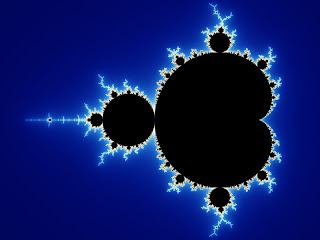
The infinitely complex Mandelbrot Set
Created by Wolfgang Beyer with the program Ultra Fractal 3
Like many others, I first became aware of fractals in the 1980s. At school I saw a video on the subject produced by Sheffield University, taking a tour of the lurid, infinitely complex Mandelbrot Set, named in Mandelbrot's honour. At home, I generated my own version of it on my home computer, the single still image taking 20 minutes to appear pixel-by-pixel on the monochrome screen. Now, advances in computing power have allowed us to see the Mandelbrot Set in immense depth. Take a look at this awe-inspiring video of the Mandelbrot Set, generated by the fractal software Fractice. The familiar shapes of the Mandelbrot Set appear again and again, ghostlike, uninvited.

Few people realise how much fractals have revolutionised our understanding of the world, and how many fractal-based systems we depend upon. The fractal mathematics Mandelbrot pioneered, together with the related field of chaos theory and the advent of computers, unveil these hidden beauties of the natural world. It inspired scientists in many fields - including cosmology, medicine, engineering and genetics - and artists, including those producing remarkably realistic computer graphics. Most well-known are the fractal images, which have inspired countless intricate pieces of art.

Fractal geometry has many practical uses. It can provide a way to understand complexity in "systems" as well as in shapes. in the architecture of the networks comprising the internet, the timing and sizes of earthquakes and the variation in a person's heartbeat and the prevalence and diagnosis of certain diseases. Fractal mathematics has also been applied to such technological developments as digital music and in computer file compression systems.

Another application of fractal theory is in the financial markets, a field Mandelbrot first worked in while studying the mathematics of complexity, working as a researcher for IBM during the 1960s. Mandelbrot applied fractal mathematics to market behaviour, in particular the profits and losses made by traders over time. Mandelbrot returned to this idea in 2005. His book "The (Mis)Behaviour of Markets" sets out a highly critical attack on the world of banking and financial systems, he stressed that the economic models in use were unable to cope with their own complexity, and he warned against the huge risks being taken by traders, who, he claimed, tend to act as if the market is inherently predictable, immune to sudden shocks or changes.

Fractal mathematics cannot be used to predict individual big events in chaotic systems, but it tells us that such events will happen. As such, it reminds us that the world is complex at every scale, and inherently unpredictable.