Friday, 19 August 2011
The Code
Have you been watching the BBC's The Code?
This three part series was a fascinating glimpse into the world of mathematics, presented by the ever-inspiring Marcus du Sautoy. It finished last week and unfortunately the BBC have already removed it from the iPlayer. But there are several clips you can still find there.
There is also a code-breaking challenge on The Code website. The cryptic questions all have answers provided by way of clues throughout the series. As far as I can tell, the clips that are still on the iPlayer contain some or all of these clues, so it is not too late to get involved.
Marcus du Sautoy, with the help of some whizzy BBC graphics and a good budget, has a great way of teaching the subject. He gives an insight into a wide variety of mathematics, even complicated areas, making them accessible to a wide audience. It's a children's programme really, as the treasure hunt on the website shows, but the depth of the presentation ensures that there is something to be learned whatever your level of maths.
All of this is really impressive stuff. It's just a shame there were only 3 episodes of The Code. Keep up the good work BBC and please, re-run the programme some time.
Labels:
BBC,
Code,
codebreaking,
Marcus du Sautoy
Thursday, 18 August 2011
Results Up, Places Down
The A-Level results are out.
First the statistics.
Once again the results have improved; this is the 29th year in a row that the overall number of passes has increased.
The percentage of A-level grades A*-E awarded has gone up very slightly, from 97.6% to 97.8%
But for the first time in 15 years there has been no increase in the total proportion getting A or A* grades. Just over 27% of entries scored these grades, with a small rise in the proportion awarded A*.
The gap seems to be closing between boys and girls. The number of A* grades for boys has gone up from 7.9% to 8.2%. For girls, the number of A* grades has fallen slightly from 8.3% to 8.2%.
More people took A-levels this year - the number of A-level grades issued is up 1.6% to 867,317.
There is good news for mathematics. Maths and the sciences have all seen significant increases in the number of entries. Maths (including Further Maths) has gone up by 7.4%. There has been a 40% increase in students taking maths over the past 5 years.
And in these subjects, the rate of improvement for boys is bigger than that for girls. The gap between boys and girls at grade A in these subjects has fallen from 0.9% to 0.3%.
Sadly, although maths and the sciences are faring well, modern foreign languages continue to decline. French and German continue their downward trend, with the number of entrants down 4.7% and 6.9% respectively
A student beginning university this year will pay a maximum of £3000 per year for the duration of their course. A student beginning next September will pay up to £9000 per year.
The fact that there are few jobs available is another factor driving people towards university.
The UCAS tracking website crashed this morning due to the sheer number of visits
Michael Gove, the education secretary, has promised a through review of the A-Level system. He is reportedly interested in moving away from the current modular structure, and towards a system whereby more emphasis is placed on a single final examination.
So congratulations if you have achieved the grades you wanted. And good luck if you are still looking for a uni place.
![]() |
| Students sitting a maths exam Image from Wikipedia |
Once again the results have improved; this is the 29th year in a row that the overall number of passes has increased.
The percentage of A-level grades A*-E awarded has gone up very slightly, from 97.6% to 97.8%
The gap seems to be closing between boys and girls. The number of A* grades for boys has gone up from 7.9% to 8.2%. For girls, the number of A* grades has fallen slightly from 8.3% to 8.2%.
More people took A-levels this year - the number of A-level grades issued is up 1.6% to 867,317.
There is good news for mathematics. Maths and the sciences have all seen significant increases in the number of entries. Maths (including Further Maths) has gone up by 7.4%. There has been a 40% increase in students taking maths over the past 5 years.
And in these subjects, the rate of improvement for boys is bigger than that for girls. The gap between boys and girls at grade A in these subjects has fallen from 0.9% to 0.3%.
Sadly, although maths and the sciences are faring well, modern foreign languages continue to decline. French and German continue their downward trend, with the number of entrants down 4.7% and 6.9% respectively
All these facts and figures do not help those who are now facing the very real scramble for places in the increasingly competitive race for university places. The increase in tuition fees, scheduled for September 2012, has been the biggest factor pushing up the number of students applying this year. Whereas many students would have previously opted for a year out while they ponder their futures, this does not make financial sense for those taking on a student loan.
A student beginning university this year will pay a maximum of £3000 per year for the duration of their course. A student beginning next September will pay up to £9000 per year.
The fact that there are few jobs available is another factor driving people towards university.
The UCAS tracking website crashed this morning due to the sheer number of visits
Michael Gove, the education secretary, has promised a through review of the A-Level system. He is reportedly interested in moving away from the current modular structure, and towards a system whereby more emphasis is placed on a single final examination.
So congratulations if you have achieved the grades you wanted. And good luck if you are still looking for a uni place.
Labels:
A-Level,
Mathematics,
Michael Gove,
results,
UCAS,
university
Wednesday, 17 August 2011
Pierre de Fermat
Today, were he still alive, Pierre de Fermat would be 410 years old.
Fermat was born on 17 August 1601 in Beaumont-de-Lomagne in southern France and lived until 12 January 1665.
He was an amateur mathematician (he was actually a lawyer), but he is now often known as the founder of modern number theory.
Together with René Descartes, Fermat was one of the two leading mathematicians of the first half of the 17th century. His work anticipated differential calculus, which was not formally laid out by Newton and Leibniz for another 50 years.
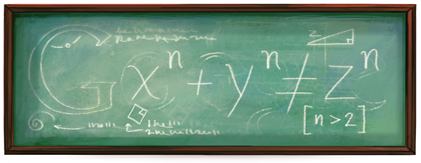
As ground-breaking as this work on calculus was, Fermat is most commonly remembered for the famous theorem that bears his name: Fermat's Last Theorem, which he studied after analysing the work of the ancient Greek mathematician Diophantus. The theorem, which is beautifully simple, states that if n > 2, there are no integer solutions to the equation:
In his notebook, Fermat wrote in pencil in the margin, "I have discovered a truly remarkable proof which this margin is too small to contain".
Did Fermat really have a remarkable proof? This will remain one of the mysteries of mathematics. But what we do know is that the world had to wait over 450 years until a proof was finally delivered by Andrew Wiles in 1995.
Another thing we know with certainty is that Wiles's proof is not the same as Fermat's proof, if indeed Fermat's existed. Wiles drew on a vast field of 20th century mathematics that simply didn't exist in Fermat's day. It is over 100 pages long and took 7 years of Wiles's research time.
Today's google logo also commemorates the birthday of the remarkable Frenchman Fermat.
![]() |
| Pierre de Fermat (1601-1665) Picture from Wikipedia |
Fermat was born on 17 August 1601 in Beaumont-de-Lomagne in southern France and lived until 12 January 1665.
He was an amateur mathematician (he was actually a lawyer), but he is now often known as the founder of modern number theory.
Together with René Descartes, Fermat was one of the two leading mathematicians of the first half of the 17th century. His work anticipated differential calculus, which was not formally laid out by Newton and Leibniz for another 50 years.
As ground-breaking as this work on calculus was, Fermat is most commonly remembered for the famous theorem that bears his name: Fermat's Last Theorem, which he studied after analysing the work of the ancient Greek mathematician Diophantus. The theorem, which is beautifully simple, states that if n > 2, there are no integer solutions to the equation:
When n = 2, you will probably recognise the equation as Pythagoras' Theorem, which, as any GCSE student will tell you, has many solutions, e.g.
The idea that there were no solutions for n > 2 seemed compelling, and the simplicity of an idea can sometimes lure us into a belief that the proof must be just as simple. Not in this case.
In his notebook, Fermat wrote in pencil in the margin, "I have discovered a truly remarkable proof which this margin is too small to contain".
Did Fermat really have a remarkable proof? This will remain one of the mysteries of mathematics. But what we do know is that the world had to wait over 450 years until a proof was finally delivered by Andrew Wiles in 1995.
Another thing we know with certainty is that Wiles's proof is not the same as Fermat's proof, if indeed Fermat's existed. Wiles drew on a vast field of 20th century mathematics that simply didn't exist in Fermat's day. It is over 100 pages long and took 7 years of Wiles's research time.
Today's google logo also commemorates the birthday of the remarkable Frenchman Fermat.
Monday, 15 August 2011
International Mathematical Olympiad
Congratulations to the team who represented the UK in the 2011 International Mathematical Olympiad. The team was put through 10 days of gruelling competition in Amsterdam from 13th – 24th July. Between them, they secured two gold, one silver and two bronze medals and also received one honourable mention.
The team and the medals awarded are as follows:
James Aaronson of St Paul's School (gold medal)
Andrew Carlotti of Sir Roger Manwood’s School (gold medal)
Ben Elliott of Godalming College (silver medal)
Adam Goucher of Netherthorpe School (bronze medal)
Jordan Millar of Regent House School (bronze medal)
Joshua Lam of The Leys School (honourable mention)
It was the first time in 15 years that the UK team was awarded two gold medals. The team finished 17th out of 101 countries. The UK entry was organised by the UK Mathematics Trust.
The problems the team faced can be downloaded from the IMO website.
More information about future olympiads can be found at the British Mathematical Olympiad website and the European Girls' Mathematical Olympiad website.
Tuesday, 9 August 2011
Why Our Schools Still Fail At Maths
There are some good points in the Maths Task Force's report to the government on the future of maths teaching in our schools. The task force, headed by Carol Vorderman, was established by the Conservative Party while they were in opposition.
![]() |
| Carol Vorderman Image from Wikipedia. |
This is not good for those individuals, whose options will be limited, and not good for employers, who increasingly need workers with at least a basic mathematical ability.
Why is this happening? The report blames a shortage of maths teachers, although it must be made clear, this is not the situation in all parts of the UK. As a result, the report concludes, a quarter of maths classes are currently being taken by non-specialists, i.e. teachers whose degree was not in mathematics. It also points out that there are shortcomings in primary education. With non-specialists being used to teach (primary teachers generally teach all subjects), they are not adequately prepared for the rigour required in mathematics.
Secondly, the report blames the way in which the curriculum has been devised. It has been formulated, it says, not by educators, but by administrators, whose understanding of what really needs to be taught in the maths classroom, is lacking.
Another key point of the report is to scrap the final vestiges of the SATs tests, those taken by 11 year olds. By "teaching to the test", teachers are narrowing the learning of their pupils, thereby preventing a broader mathematical understanding, which would give them a far better grounding for secondary school.
Michael Gove, the education secretary, backs the suggestions in the report. Even before it was released, Gove was talking about compulsory maths teaching up to the age of 18.
So, what should we make of the Task Force report?
The shortage of maths specialists in our schools is fundamental and must be addressed. There is no substitute for clear, authoritative, imaginative and well-thought out teaching. Addressing this problem alone would go a long way to solving the problem. This raises questions of teachers' pay, attracting academic excellence into the teaching profession, and why it is impossible to hire good quality teachers at certain schools, but these are issues that must wait for another time.
It is easy to blame SATs, which have been condemned by teachers ever since their introduction. Key Stage 2 SATs are a waste of time and they force teachers to focus on teaching to the test alone, which narrows the field of the pupils' learning. These things are true, and SATs should certainly be abolished. But it is hard to believe they can seriously impact on a child's mathematical progression through secondary school and beyond.
Thirdly, teaching of maths to all pupils to the age of 18 would be very difficult to implement. Trying to teach a class full of pupils who had failed their GCSE, who thought they were going to be free of mathematics, only to find they have another 2 compulsory years of it, does not sound like a good idea, especially if these compulsory lessons were not going to lead to any proper qualification.
So the report's findings are mixed. Compulsory maths teaching to the age of 18, on its own, is not going to fix this chronic, very real problem. Unless the pupils who emerge without a C at GCSE are given some serious incentives to study their loathed subject for another two years, this idea is doomed to failure. What would? Teaching better, by good quality teachers, not necessarily for longer.
The CBI, some universities and FE colleges have welcomed the report and praised the suggestion of compulsory maths education to the age of 18. However, the National Union of Teachers has said it does not understand the need for such a report, given that a full review of the National Curriculum is underway. We say: care and serious consideration is required. We have discussed the curious decisions of the education secretary before on this blog. Be careful what you wish for Mr Gove.
Tuesday, 28 June 2011
Happy Tau Day
Happy Tau Day!
Happy what day? Tau is a mathematical constant, whose value is 6.28... . Is that ringing any bells? Correct:
OK, so tau being 6.28 explains why 28th June is Tau Day (blame the Americans - they write their dates backwards). But why do we need a new mathematical constant, especially one that is simply double another one?
Some maths teachers and academics have been in favour of using tau instead of pi in maths teaching, particularly in early years. It's because 2 pi seems to crop up a lot, probably more often than a single pi, particularly in geometry and trigonometry. For example, the circumference of a circle is given by:
If tau were widely adopted, this would be replaced by:
Personally, I'm not convinced. Tau would certainly be useful in a number of formulae and mathematical solutions. But I think students would end up using a half of tau just as often as they currently use 2 pi.
And if we went to a system where both constants were in use, would this not just add to the confusion, rather than alleviate it?
Finally there are thousands of years of pi tradition. The ancient Greeks obsessed over pi, just as much as modern mathematicians do.
What do you think of tau?
Happy what day? Tau is a mathematical constant, whose value is 6.28... . Is that ringing any bells? Correct:
OK, so tau being 6.28 explains why 28th June is Tau Day (blame the Americans - they write their dates backwards). But why do we need a new mathematical constant, especially one that is simply double another one?
Some maths teachers and academics have been in favour of using tau instead of pi in maths teaching, particularly in early years. It's because 2 pi seems to crop up a lot, probably more often than a single pi, particularly in geometry and trigonometry. For example, the circumference of a circle is given by:
And if we went to a system where both constants were in use, would this not just add to the confusion, rather than alleviate it?
Finally there are thousands of years of pi tradition. The ancient Greeks obsessed over pi, just as much as modern mathematicians do.
What do you think of tau?
Thursday, 9 June 2011
Exam Standards Are Slipping (That's The Papers, Not the Candidates)
You may be used to the idea of going into exams to find questions you find impossible to answer.
If you sat the OCR Decision Maths 1 exam on 26th May you will certainly have found yourself in this situation; one of the questions had no solution.
This embarrassing slip-up was the first of five errors on AS exam papers this summer. The other mistakes came to light on:
Reports are also circulating of mistakes on a CCEA business studies GCSE and one more, undisclosed paper.
- an AQA Business Studies paper, in which there was not enough information to answer the question;
- an Edexcel Biology multiple choice exam, in which none of the answers given were correct;
- an AQA Geography paper, in which the flow of a river was incorrectly labelled at one point;
- an AQA Computing AS Level paper, in which an arrow was shorter than it should have been.
Reports are also circulating of mistakes on a CCEA business studies GCSE and one more, undisclosed paper.
Jim Sinclair, Director of the Joint Council for Qualifications, said that procedures were in place to cope with these errors.
In the case of the Decision Maths, the question was worth 8 marks out of 72, or 11% of the total marks awarded for the paper. The exam board OCR have decided not to discount the question from the paper, since it was worth such a large percentage of the marks. Instead, they will award marks for correct working, which will reward pupils who spent some of their time attempting to answer the question.
But many students are unhappy with this proposal. Facebook groups have been formed to demand a complete rerun of the exam. Some students think the time they wasted will jeopardise their chances of them getting the grades required for their university applications.
More details about the impossible D1 question are here.
Our advice to examination candidates has always been: if you can't do a question on the paper, leave it and come back to it if you have time at the end. It may be time to modify this advice: leave it; it may not be possible anyway.
Subscribe to:
Posts (Atom)